 RotiAI


If you eat desi food, “how many calories in roti/chapati” (روٹی/چپاتی) is probably the single most useful number you can learn — because roti shows up at almost every meal. The short honest answer: a plain whole-wheat roti is roughly 70–120 calories, depending mostly on its size and how much flour went into it. This guide breaks down exactly what makes that number move, so you can count your own roti instead of trusting a random figure online.
The quick calorie answer
Roti calories are really just a function of how much atta (whole-wheat flour) is in the dough, plus any oil or ghee added. Water and cooking on a dry tawa add almost nothing. Here are honest, real-world ranges:
| Roti size | Approx. flour | Approx. calories |
|---|---|---|
| Small (~6 inch) | ~20–25 g atta | 70–85 kcal |
| Medium (~7 inch) | ~30 g atta | 90–110 kcal |
| Large (~8–9 inch) | ~40–50 g atta | 120–150 kcal |
| Phulka / thin roti | ~20 g atta | ~70 kcal |
These are ranges on purpose — a “roti” isn’t a standardized unit. The 8-inch tandoori-style roti at a dhaba and the thin phulka your nani makes at home are genuinely different foods, calorie-wise. When in doubt, weigh the flour: whole-wheat atta is about 340 calories per 100 g, and your roti keeps roughly that ratio of whatever flour you rolled into it.
What makes the number go up
- Ghee or oil. A roti brushed with ghee or a paratha-style fold adds roughly 30–45 calories per teaspoon of fat. This is the biggest swing factor — a plain roti and a chupri (ghee-smeared) roti can differ by 40+ calories.
- Size and thickness. A thick, hearty roti simply has more flour. Two thin phulkas can weigh less than one thick roti.
- Flour type. Whole-wheat (atta) and refined white (maida) are close in raw calories, but atta’s fiber keeps you fuller for longer, so you tend to eat fewer of them.
- Add-ins. Missi roti (with besan), bajra, or jowar rotis shift the number slightly, but they’re in the same ballpark as wheat.
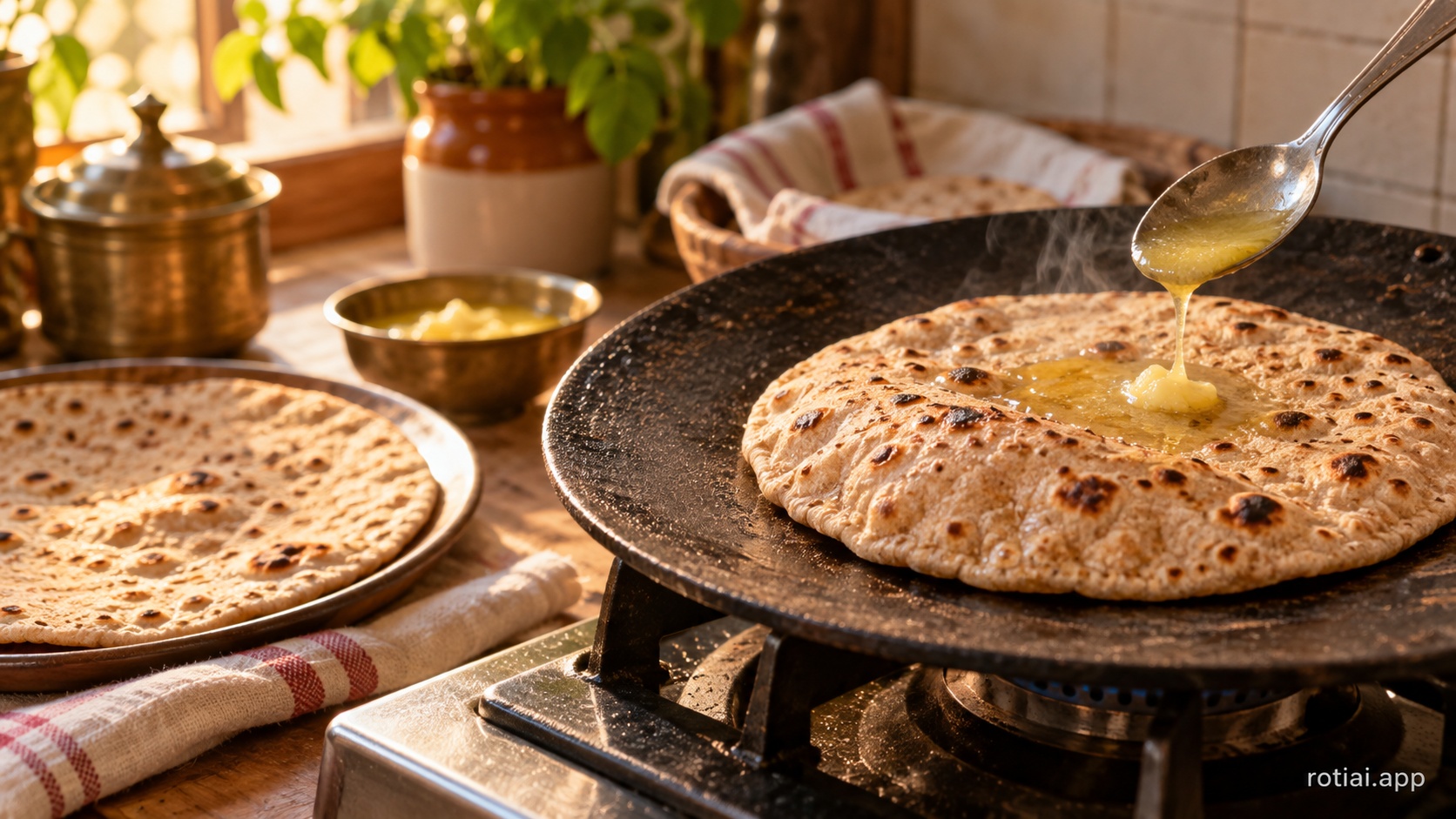
Roti vs chapati vs phulka — same thing?
For calorie purposes, roti and chapati are the same food — both are unleavened whole-wheat flatbreads cooked on a tawa. “Phulka” usually means a thinner roti puffed directly over the flame, so it’s often on the lighter end. Naan is the outlier: it’s made with maida, yogurt, and sometimes oil, so a naan runs 250–350 calories — far heavier than a roti. If you’re watching calories, roti beats naan every time.
Is roti good for a desi diet?
Yes — with portion sense. Whole-wheat roti brings fiber, some plant protein, and slow-release carbs, which is exactly why it’s a better everyday base than white rice or naan for most people.
The trouble is never the roti itself; it’s the count. Three or four large ghee-brushed rotis at dinner can quietly add 500+ calories before you touch the salan. A practical rule for weight management: pick your roti count first (say, two medium), then build the plate around it.
How roti fits your daily calories
Think of roti as your “carb budget” for a meal. Two medium rotis (~200 calories) plus a bowl of daal or a portion of sabzi is a genuinely balanced, filling desi meal well under 500 calories. Swap in one roti instead of two and add extra salad if you’re cutting. The dish sitting next to the roti — keema, korma, ghee-heavy salan — usually matters more for your total than the roti does.
Roti macros: what’s actually in a medium roti
Calories only tell part of the story. A medium whole-wheat roti (~30 g atta) breaks down roughly like this:
| Macro | Approx. amount | Why it matters |
|---|---|---|
| Carbohydrates | ~18–22 g | Mostly complex carbs, digested slower than white rice or maida |
| Protein | ~3 g | Small but adds up across 2–3 rotis per meal |
| Fat | ~0.5–1 g plain | Jumps to 4–5 g if brushed with a teaspoon of ghee |
| Fiber | ~2–3 g | The main reason roti keeps you fuller than naan or plain rice |
Roughly 75–80% of a plain roti’s calories come from carbohydrate, which is exactly why the “count your rotis” advice matters more than any other single portion rule in a desi meal.
Roti portions compared to other everyday carbs
It helps to see roti next to the carbs it usually competes with on a plate:
| Carb source | Typical serving | Approx. calories |
|---|---|---|
| 1 medium roti | 1 piece (~30 g atta) | ~100 kcal |
| 1 cup cooked white rice | ~150 g | ~200 kcal |
| 1 cup cooked brown rice | ~150 g | ~215 kcal (more fiber) |
| 1 plain dosa | 1 medium dosa (80 g) | ~168 kcal |
| 1 idli | 1 piece (38 g) | ~49 kcal |
| 1 naan | 1 piece | 250–350 kcal |
| 1 paratha (plain) | 1 piece | 250–300 kcal |
| 2 slices white bread | 2 slices | ~130–160 kcal |
South Indian breakfasts sit close to roti in calories before the sides are added: a medium plain dosa is about 168 kcal and one idli about 49, while a full plate of masala dosa with sambar comes to about 470 kcal because of the potato filling and the sambar. To compare whole dishes rather than single pieces, the Pakistani breakfast recipes page ranks six nashta ideas by calories a serving, and the Pakistani rice recipes page does the same for rice dishes.
For the richer end of the hub, Kabuli pulao is about 610 kcal a serving and chapli kebab about 430 for two. In the Pakistani-Chinese group, veg hakka noodles come to about 420 kcal and chicken manchurian about 360, while hot and sour soup is about 93. For everyday home plates, see aloo anda at about 360 and bhuna khichuri at about 410.
Gram for gram, roti is one of the lighter carb options on a desi table — the naan and paratha comparisons are usually the real eye-opener for people trying to cut calories without giving up bread altogether. For a closer look at the roti-vs-rice question specifically, see roti vs rice for weight loss.
Roti calories by flour: atta, maida, bajra, jowar, besan
“Roti” is a method, not an ingredient, so the flour you roll changes the count a little. This table uses a medium roti made from 30 g of dry flour, with approximate typical USDA values per 100 g, before any ghee or oil:
| Flour | Per 100 g | A 30 g roti | What changes |
|---|---|---|---|
| Whole-wheat atta | ~340 kcal | ~102 kcal | The everyday baseline, with the bran and fiber kept in |
| Maida (refined wheat) | ~364 kcal | ~109 kcal | Slightly higher, and less fiber, so it fills you up less |
| Bajra (pearl millet) | ~378 kcal | ~113 kcal | Denser and a little richer in fat, so a thick bajra roti is heavy |
| Jowar (sorghum) | ~329 kcal | ~99 kcal | The lightest of the group and naturally gluten-free |
| Besan (gram flour, as in missi roti) | ~387 kcal | ~116 kcal | The most protein per gram, which is why missi roti is more filling |
| Makki (cornmeal) | ~361 kcal | ~108 kcal | Gluten-free, and usually rolled thick, so a makki roti is bigger than it looks |
The spread between the lightest and the heaviest flour is only about 17 kcal per roti, so flour choice matters far less than size and fat. Pick the flour for fiber, taste and gluten, not for a calorie saving. Mixed-flour rotis (atta with a little besan or bajra) land in between.
How much do ghee, oil and butter add to a roti?
Fat is the biggest swing factor, because it is about 9 kcal a gram, more than twice the 4 kcal a gram of flour. One teaspoon of ghee or oil weighs roughly 4.5 g and adds about 40 kcal, which is a third of a whole plain roti.
| How the roti is finished | Added fat | Total for a medium roti |
|---|---|---|
| Dry on the tawa, nothing added | none | ~100 kcal |
| A thin brush of ghee after cooking | ~1/2 tsp | ~120 kcal |
| Ghee smeared on one side (chupri roti) | ~1 tsp | ~140 kcal |
| Oil in the dough and ghee on top | ~1.5 tsp | ~160 kcal |
| Butter on a hot roti | ~1 tsp | ~135 kcal |
This is why the same “two rotis” can be 200 kcal at one table and 320 at another. If you only change one habit, change this one: measure the ghee with a spoon instead of pouring it, or ghee only the first roti for the family.
Roti vs paratha, puri, naan and tandoori roti
Most “is roti healthy?” questions are really “is the bread I actually eat healthy?” Typical ranges for one piece, since none of these is a standard unit:
| Bread | How it is made | Approx. calories per piece |
|---|---|---|
| Phulka | thin, dry, puffed over flame | 60–75 |
| Roti / chapati | whole wheat, dry tawa | 90–110 |
| Tandoori roti | whole wheat, larger and thicker, tandoor | 120–150 |
| Plain paratha | folded with ghee or oil, shallow-fried | 250–300 |
| Aloo paratha | stuffed with spiced potato | 300–380 |
| Puri | deep-fried | 100–130 |
| Naan | maida, yogurt and oil, tandoor | 250–350 |
Roti stays the lightest everyday option because it carries no cooking fat. A paratha is not “a roti with more flavour”: it is two to three rotis’ worth of calories on one plate.
How many rotis a day for your calorie goal?
A planning guide for adults, assuming roti is one of several carbs in the day. These are typical starting points, not medical advice, and your activity, age and goal move them:
| Daily calorie target | Medium rotis a day | Calories from roti | Share of the day |
|---|---|---|---|
| 1,400–1,500 (steady loss) | 2–3 | 200–300 | 14–20% |
| 1,700–1,900 (gentle loss or small frame) | 3–4 | 300–400 | 16–22% |
| 2,000–2,300 (maintenance) | 4–5 | 400–500 | 18–23% |
| 2,500+ (very active) | 5–6 | 500–600 | 20–24% |
Split them across meals rather than saving them all for dinner, and put protein (daal, eggs, chicken, yogurt) next to the roti so the carbs digest slower. For a full day of eating built this way, see the 7-day Pakistani diet plan for weight loss and the desi weight-loss meals list.
How to count the roti you actually make
Roti sizes differ more than any other food, so measure once and reuse the number:
- Weigh one cooked plain roti on a kitchen scale. Plain cooked roti is about 3 kcal per gram (USDA lists plain chapati at close to 300 kcal per 100 g). A 35 g roti is about 105 kcal; a 50 g roti is about 150.
- Or weigh the dry flour per roti. Roll out the dough balls from, say, 300 g of atta, count how many rotis you get, and divide. Ten rotis from 300 g is 30 g of atta each, about 102 kcal.
- Add the fat separately. About 40 kcal for each teaspoon of ghee or oil, counted per roti, not per batch.
- Check the pair, not just the bread. The salan beside the roti is usually the larger number, which is why the dish pages below give a per-serving figure for the curry alone.
What the roti sits next to: full plates
Two medium rotis are about 200 kcal, so a plate’s total is mostly the dish you pair them with. Each of these pages gives the kcal for the dish alone, per serving:
- Aloo anda: about 360 kcal, a potato-and-egg nashta that lands near 520 kcal with two rotis.
- Bhindi with roti: about 410 kcal for a serving of the okra dish.
- Lauki ki sabzi with roti: about 350 kcal, the lighter vegetable option.
- Anda bhurji with roti: about 320 kcal, high in protein for the carbs.
- Daal chawal: about 380 kcal when you want the rice version of the same meal.
- Moong daal khichdi: about 330 kcal, the gentle option for a light dinner.
To cook the same dishes, the matching recipes are anda bhurji roti, bhindi roti and lauki ki sabzi roti. The low-cal desi swaps page covers what to change when a plate is running high.
Where to go next
- Calories in chapati — size, macros and the per-roti breakdown in one place.
- Roti vs rice for weight loss — which carb to build a cutting plate around.
- Low-cal desi swaps — what to change when a plate runs high.
Where the calorie numbers on this site come from
Every page on this site starts from USDA FoodData Central (the US government’s public nutrition database) for ingredient values, and from RotiAI’s own recipe lists (cups, spoons and counts, serves 4 unless stated) for the dish. Three examples of the raw values we use per 100 g: whole-grain wheat flour is 340 kcal (FDC 168893), so a roti made from 30 g of atta is about 102 kcal before any ghee; plain dosa is 210 kcal (FDC 2708347); idli is 128 kcal (FDC 2708346). Dish figures are estimates, not laboratory values, and each page says what its serving is. The full method, the sources we could not confirm, and how to report an error are on how we calculate; who writes the pages is on about RotiAI.
Frequently asked questions about roti and chapati calories
How many calories are in 2 rotis?
Two medium plain rotis are about 200 kcal, two thin phulkas about 130–150, and two large ghee-brushed rotis 280–320. The number follows the size and the ghee, not the count, so measure your own roti once using the weigh-it method above.
Is a roti with ghee really that much higher?
Yes. A teaspoon of ghee is about 40 kcal, so a ghee-smeared roti is around 140 kcal against 100 for a dry one. Over three rotis that is about 120 kcal a meal from fat alone.
Does leftover or cold roti have fewer calories?
No. Cooling does not remove calories. Cold starch does become slightly more resistant to digestion, but the effect is small, so do not count a leftover roti as lighter.
Is roti or rice better for weight loss?
Per piece, one medium roti (about 100 kcal) is lighter than a cup of cooked white rice (about 200 kcal), and it carries more fiber. Portion matters more than the choice; the roti vs rice page compares them plate by plate.
Does the type of tawa or cooking method change the calories?
Barely. Whether you cook roti on an iron tawa, a non-stick pan, or over an open flame (for phulka), the calorie count comes from the flour and any oil/ghee added — the cooking surface itself adds nothing.
Is a roti made with maida different from one made with atta, calorie-wise?
Almost identical calorie-for-calorie — both flours run close to 340–360 kcal per 100 g. The real difference is fiber: atta keeps the bran, so it digests slower and fills you up more per calorie than maida.
How many rotis should I eat a day to lose weight?
There’s no universal number, but most people cutting calories do well with 2–4 medium rotis spread across the day, paired with protein and vegetables. What matters more than the exact count is consistency — swapping one roti for extra salad most days adds up faster than skipping roti entirely for a week and going back to three.
Do rotis have gluten?
Yes — standard atta is whole-wheat, so it contains gluten. Bajra, jowar, or besan-based rotis are naturally gluten-free alternatives if that’s a concern.
Is roti okay for diabetics?
Whole-wheat roti’s fiber gives it a lower glycemic impact than white rice or naan, which is why it’s commonly recommended over refined-flour options — but portion size and what’s eaten alongside it (like a sugar-heavy curry) still matter. Always check with a doctor for personalized advice.
Count your own roti automatically
Every roti is a little different, and eyeballing gets tiring. RotiAI computes the exact kcal for your roti and any desi dish you pair it with — just tell it the size and what’s on the plate. And if you’re eating for a goal, Sehat Mode turns those counts into a personalized desi diet plan built around the food you actually eat, roti included.
For real dish-by-dish numbers, browse pairings like anda bhurji with roti or bhindi with roti, or check the full chapati nutrition breakdown breakdown.
Looking beyond the everyday Punjabi table? The calorie hub also covers regional dishes from the app’s catalog — from a Sindhi koki breakfast and sai bhaji, to Pashtun namkeen gosht, kabuli pulao, and chapli kebab, Bengali shorshe mach and bhuna khichuri, and South Indian masala dosa, idli sambar, and pepper rasam rice.