 RotiAI

Veg manchurian (ویگ منچورین) — cabbage, carrot and beans bound and fried into crisp balls, then tossed in a hot soya-chilli sauce — is about 330 calories per serving for the dry homemade style. It is the lowest-calorie flagship of the Pakistani-Chinese family, which is exactly why it earns a place on a lighter weeknight plate more often than its chicken and chilli-chicken cousins. If you searched for just “manchurian calories”, there are two versions on this site: this vegetable one at about 330 kcal and chicken manchurian at about 360.
Quick answer
- Calories: ~330 kcal per serving (dry, homemade)
- Serves: 4 · Cook time: 35 min
- Region: Pakistani-Chinese · Tags: veg, spicy, dry
Calories in Veg Manchurian: the count
~330 calories per serving. A serving is deep-fried vegetable balls — mostly cabbage, carrot and beans — in a thin soya-and-chilli glaze. The vegetables themselves are very low-calorie; what carries the count is the cornflour-and-maida batter and the oil the fried crust holds. That is also why the cooking method moves the number more than anything else.
Why Veg Manchurian lands at this number
- Vegetables are the low-calorie base. Cabbage, carrot and beans add bulk and fibre for almost nothing, which keeps the count under the chicken and chilli-chicken versions.
- The batter is the carb. Cornflour and maida bind and crisp the balls — that is where the carbohydrate calories come from.
- Frying is the fat swing. The crust soaks up oil, and veg balls soak up a fair bit because the batter is thicker than a chicken coating. Less oil, lower number.
Veg Manchurian macros at a glance
Veg manchurian is a moderate-carb, moderate-fat, low-protein dish. The vegetables bring fibre and volume, the batter brings carbs, and the frying oil brings most of the fat. The trade-off for the lower calorie count is that it is lighter on protein than the chicken versions, so pair it with something protein-rich if it is your main.
How Veg Manchurian fits a desi diet
At ~330 calories, the dry homemade version is the easiest Pakistani-Chinese dish to fit into a fat-loss plan: the vegetable base keeps it filling on relatively few calories, and it is already the lightest of the three manchurian-and-chilli staples. To keep it that way, air-fry or shallow-fry the balls, go light on the sauce, and avoid the gravy style and restaurant portions — both push it well above the homemade number.
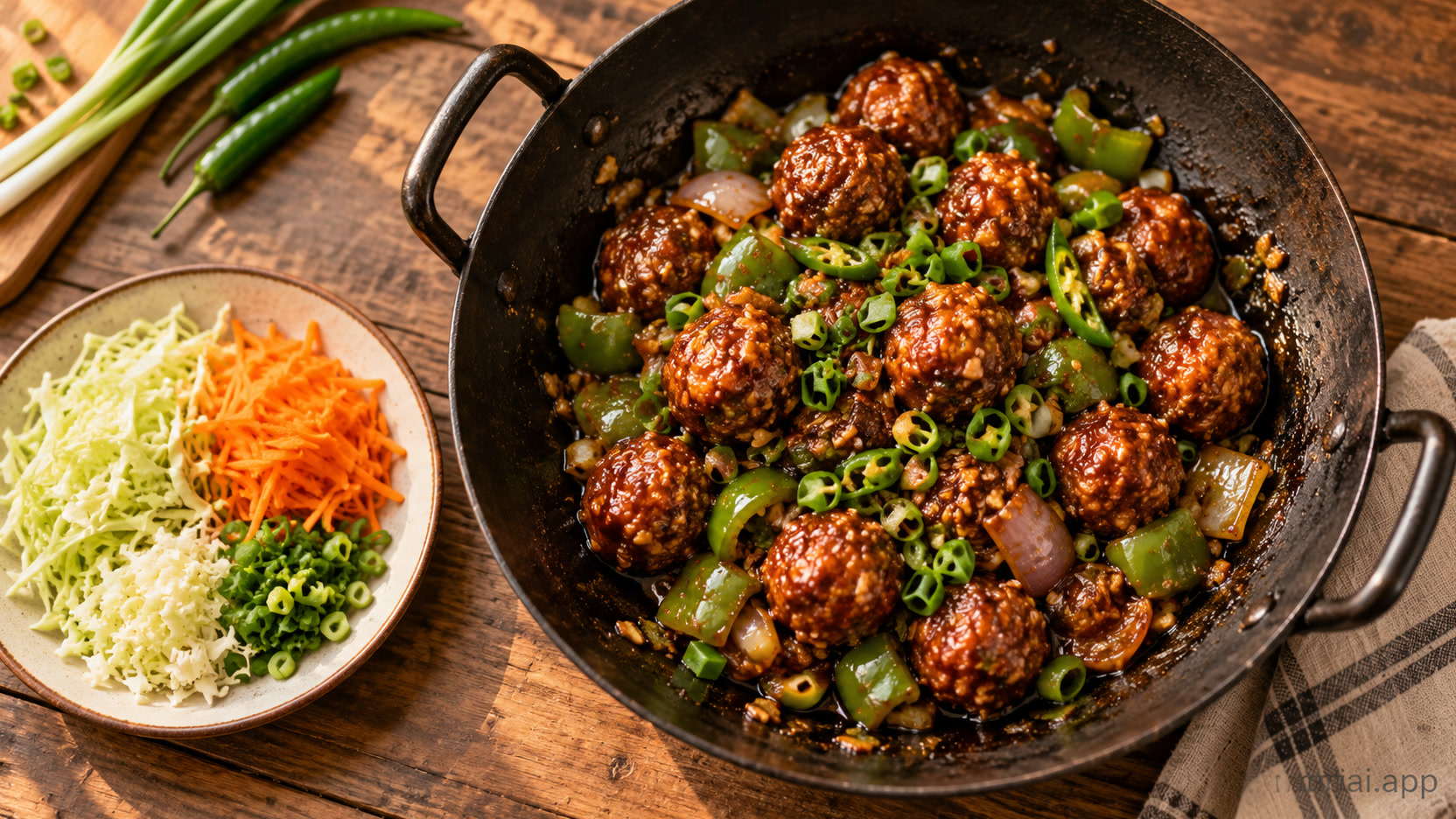
Veg Manchurian: full macro breakdown
For a standard ~330-calorie serving of dry homemade veg manchurian (fried vegetable balls, thin batter, sauce to glaze):
| Macro | Approx. amount | % of calories |
|---|---|---|
| Protein | 6–8 g | ~9% |
| Carbohydrates | 28–32 g | ~37% |
| Fat | 14–16 g | ~42% |
| Fiber | 3–4 g | — |
The fibre from the cabbage and vegetables is the quiet win here — it is the reason this dish feels filling for so few calories. The protein is the weak spot, so if you make it a main, add a protein side rather than more manchurian.
Veg Manchurian portion size comparison
Method and style move the count more than portion size:
| Version | What changes | Calories per serving |
|---|---|---|
| Air-fryer version | Oil sprayed, not deep-fried | ~250–270 |
| Dry, homemade (this recipe) | Deep-fried, thin glaze only | ~330 |
| Gravy veg manchurian | Sauce thickened with stock and cornflour | ~380–410 (approx.) |
| Restaurant veg manchurian | More oil, thicker batter, sugar in the sauce | ~420–480 |
| With steamed rice | Dry veg manchurian + a portion of steamed basmati | add ~200–230 |
The gravy and restaurant figures are approximate — they depend on the batter thickness and how much sugar and oil the kitchen uses.
Tips for a lighter Veg Manchurian
- Air-fry or bake the balls. A light oil spray instead of a deep fry is the single biggest calorie cut you can make to this dish.
- Load up the veg, trim the flour. More grated vegetables and just enough flour to bind means more volume and fibre for the same or fewer calories.
- Glaze, don’t drown. A thin sauce costs almost nothing; a thick gravy is where the extra carbs and calories sneak in.
- Pair protein, not carbs. A side of egg fried rice or extra manchurian raises the count; a protein side keeps it light and keeps you full longer.
Frequently asked questions about Veg Manchurian calories
How many calories are in veg manchurian?
About 330 calories per serving for the dry homemade version. Gravy veg manchurian lands around 380–410, and restaurant portions can reach 420–480 because of more oil and sugar in the sauce.
Is veg manchurian good for weight loss?
Of the Pakistani-Chinese starters, it is one of the best choices — the vegetable base is filling on few calories, and the dry homemade style keeps it light. Make it weight-loss-friendly by air-frying, cutting the batter, and keeping the sauce thin.
Is veg manchurian healthier than chicken manchurian?
Lower in calories, yes — about 330 versus roughly 360 for the dry versions — but both are deep-fried and batter-coated, so “healthier” here means lighter, not a health food. Chicken manchurian wins on protein; veg manchurian wins on calories and fibre. See calories in chicken manchurian to compare.
Can I make veg manchurian with less oil?
Yes. Air-fry or bake the balls with a light spray and toss them through the same sauce. You can drop from roughly 330 to around 250–270 per serving without losing the dish’s character.
Is veg manchurian vegetarian and halal?
Yes — the base is vegetables, flour and egg, so it suits a vegetarian and halal table. Just check that the sauces are alcohol-free if you are strict, and skip the egg with a cornflour slurry binder if you want it vegan.
How we calculate veg manchurian calories
Every ingredient value below is read from USDA FoodData Central (per 100 g, raw unless stated). The recipe gives home measures, so the gram weights come from the same USDA records where they list a cup weight: cornstarch 128 g per cup, white flour 125 g per cup, soybean oil 218 g per cup.
| Ingredient (recipe amount) | USDA record | kcal per 100 g | Protein / carbs / fat per 100 g |
|---|---|---|---|
| Cabbage | FDC 169975 | 25 | 1.3 g / 5.8 g / 0.1 g |
| Carrots | FDC 170393 | 41 | 0.9 g / 9.6 g / 0.2 g |
| Green beans | FDC 169961 | 31 | 1.8 g / 7.0 g / 0.2 g |
| Cornflour, 1/2 cup (about 64 g) | FDC 169698 (cornstarch) | 381 | 0.3 g / 91.3 g / 0.1 g |
| Maida, 1/4 cup (about 31 g) | FDC 169761 (white flour, unenriched) | 364 | 10.3 g / 76.3 g / 1.0 g |
| Egg, 1 | FDC 171287 | 143 | 12.6 g / 0.7 g / 9.5 g |
| Soy sauce | FDC 174277 | 53 | 8.1 g / 4.9 g / 0.6 g |
| Frying oil, 3/4 cup (about 164 g) | FDC 172370 (soybean oil, stand-in for cooking oil) | 884 | 0 g / 0 g / 100 g |
What this shows: the whole batch’s flour (about 357 kcal) and egg are small next to the oil. If all 164 g of frying oil ended up in the balls it would add about 1,445 kcal, roughly 361 kcal per serving, which is more than the 330 kcal figure for the whole serving. So most of the oil stays in the pan, and the share the crust absorbs is the number nobody can read off a label: it is why air-frying, which skips that step, is the biggest change you can make. The calorie figure for the serving is RotiAI’s recipe estimate, not a lab measurement. Method: how we calculate.
Related reading on Veg Manchurian
- Veg Manchurian recipe — the full step-by-step dry-style method
- Calories in Chicken Manchurian — the higher-protein cousin, and how it compares
- Calories in Chilli Chicken — the chilli-sauce starter, and the oil difference
- Calories in Veg Hakka Noodles — the other meatless Pakistani-Chinese favourite, about 420 kcal
- Calories in Hot and Sour Soup — a starter at about 93 kcal, for the lightest end of the family
Get the exact calorie count for Veg Manchurian
The batter thickness and how much oil the crust holds are the variables. RotiAI computes the exact kcal for your veg manchurian, and Sehat Mode builds lighter Pakistani-Chinese meals into a personalized desi diet plan.


