 RotiAI

The fastest way to cut calories from desi food isn’t giving up your favourite dishes — it’s making small, low-cal swaps that keep the flavour and lose the excess oil and refined carbs. These desi food swaps actually work because they’re realistic: same taste, same comfort, fewer calories. Here are the ones worth building into your everyday cooking.
Quick note: this is general food guidance, not medical advice. If you have a health condition or specific dietary needs, check with a doctor or nutritionist before overhauling your diet.
1. Fried → baked or grilled
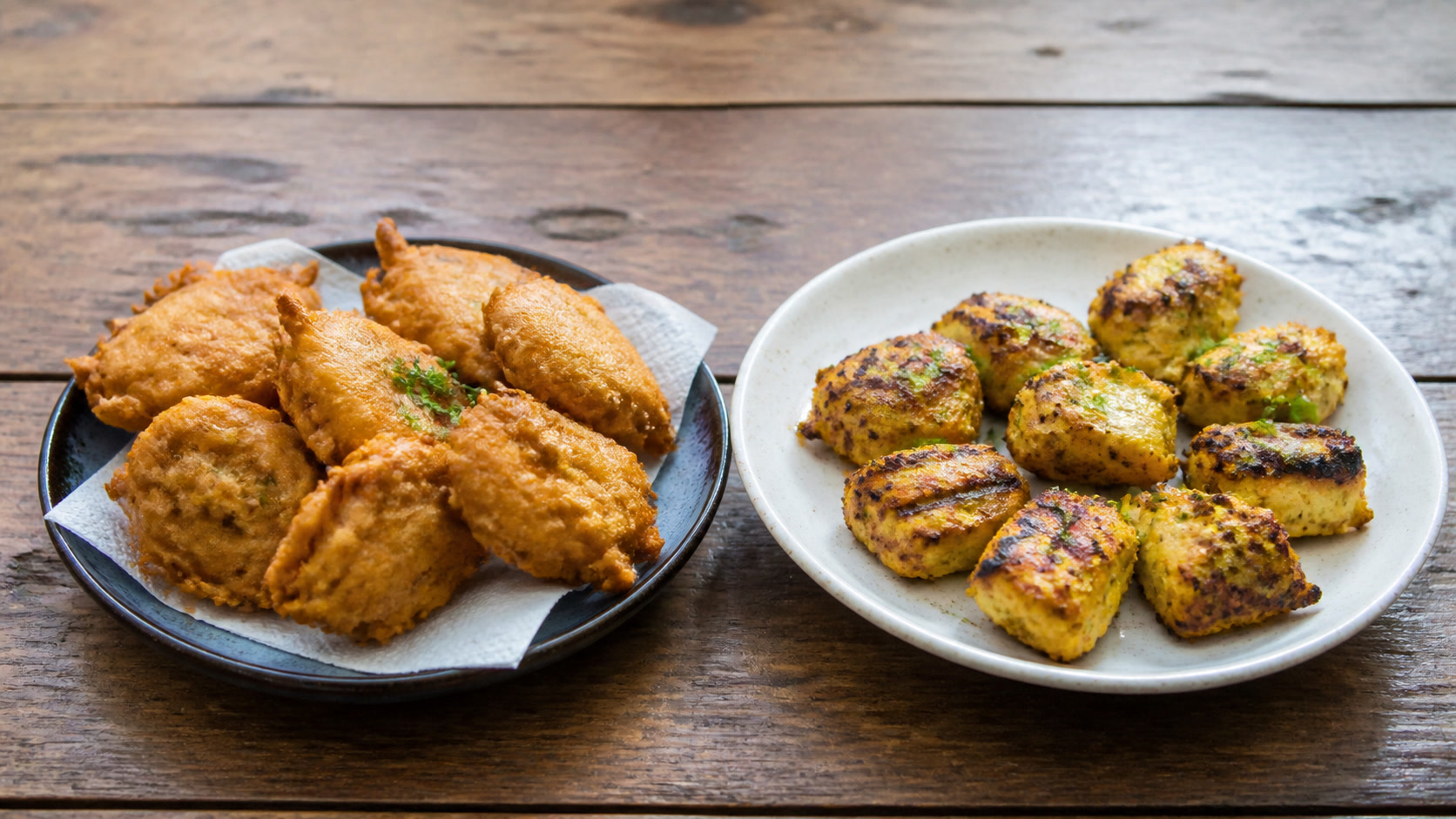
This is the single biggest win in desi cooking. Deep-frying soaks food in oil; grilling and baking let the fat drip away.
- Fried chicken → Tandoori Chicken (baked). Our Tandoori Chicken + Raita (380 kcal) is marinated in yogurt and spices, then roasted on a wire rack in the oven so the fat runs off — none of the deep-fried batter.
- Fried fish → seared Fish Curry. In our Fish Curry + Rice (400 kcal), the fish is lightly seared and simmered in a tomato-yogurt gravy instead of being battered and deep-fried.
- Try air-frying pakoray if you crave them: an air-fryer or a light oven bake gives you the crunch with a fraction of the oil.
2. Deep-fried karahi → kam-tel (low-oil) cooking
You don’t need a floating layer of oil for flavour. Low-oil desi dishes prove it:
- Regular keema → Keema Karahi (kam tel). Our Keema Karahi (460 kcal) uses lean mince and just 3 tbsp of oil across the whole dish, building flavour from tomatoes and spices instead of grease.
- Measure your cooking oil with a spoon instead of pouring straight from the bottle — you’ll often use half as much without noticing.
3. White rice → brown rice
A simple grain swap that adds fibre and keeps you full longer:
- Plain white rice → brown basmati. Our Masoor Daal + Brown Rice (440 kcal a serving, one sixth of the recipe) pairs lentils with brown rice for about 8 g of fibre and 17 g of protein. Brown rice has about the same calories as white, so the saving comes from the portion.
4. Heavy breakfast → protein-forward breakfast
- Oily paratha → Anda Bhurji + one roti. Our Anda Bhurji + Roti (320 kcal) gives you a protein-rich start with just one whole-wheat roti, instead of a ghee-laden paratha.
- Puri/paratha → Besan Cheela. Our Besan Cheela + Dahi (325 kcal for 2 cheelas) cooks on a non-stick tawa with barely half a teaspoon of oil per cheela — a savoury, high-protein swap for fried breakfast breads.
5. Fried snacks → high-protein or high-fibre snacks
The 5 pm snack is where a lot of desi diets quietly go wrong. Swap the fried stuff:
- Samosa / pakoray → Chana Chaat. Our Chana Chaat (330 kcal) is fibre and plant protein with a tangy chaat-masala kick — genuinely satisfying, and no frying.
- Biscuits with chai → Chicken Yakhni Soup. A warm bowl of Chicken Yakhni Soup (190 kcal) is savoury, filling and one of the lowest-calorie options anywhere on the menu.
6. Rich curries → light vegetable and lentil dishes
- Creamy, oily gravies → Lauki ki Sabzi. Our Lauki ki Sabzi + Roti (350 kcal) cooks the bottle gourd down in its own water, so it needs less oil than a creamy gravy.
- Heavy daal makhani → Moong Daal Khichdi. Our Moong Daal Khichdi (350 kcal) is light, easy to digest, and perfect for a gentle dinner.
7. Sugary drinks → plain drinks
Not a dish, but it matters: two or three sweetened chais or a bottle of soft drink a day can quietly add hundreds of calories. Cut the sugar in your chai, or switch to black/green tea and water. This one swap alone can make a real difference over a week.
The swaps at a glance
| Instead of… | Try… | Calories | Why |
|---|---|---|---|
| Fried chicken | Tandoori Chicken + Raita | 380 | Baked, not fried — fat drips off |
| Battered fried fish | Fish Curry + Rice | 400 | Seared and simmered, not deep-fried |
| Oily keema | Keema Karahi (kam tel) | 460 | Lean mince, just 3 tbsp oil |
| White rice | Masoor Daal + Brown Rice | 440 | More fibre; similar calories to white rice per gram |
| Oily paratha breakfast | Anda Bhurji + Roti | 320 | High protein, one roti |
| Fried breakfast breads | Besan Cheela + Dahi | 325 | Non-stick, minimal oil |
| Samosa / pakoray snack | Chana Chaat | 330 | Fibre + plant protein, no frying |
| Biscuits with chai | Chicken Yakhni Soup | 190 | Warm, filling, very light |
| Creamy gravy | Lauki ki Sabzi + Roti | 350 | Cooks in its own water, so it needs less oil |
The one rule behind all of them
Every swap here follows the same idea: keep the desi flavour, cut the oil and refined carbs, and add protein or fibre. You’re not eating “diet food” — you’re eating the same food, cooked smarter. Do a few of these consistently and the calories add up in your favour without you ever feeling deprived.
How much oil are you actually saving?
Oil is the single biggest hidden calorie source in desi cooking — 1 tablespoon is about 120 kcal, and a lot of home cooking pours in 6-8 tbsp per pot without measuring. Cut a karahi from 8 tbsp to 3 tbsp across 4 servings and you’ve saved roughly 150 kcal per serving before you’ve changed a single spice. That’s the real mechanism behind most of the swaps above: it’s rarely the protein or the carb that’s the problem, it’s the oil sitting on top of it.
- Measure with a spoon, every time — even when you’re confident you “just added a little.”
- Use a non-stick tawa or pan for anything you’d normally shallow-fry (cheela, tikka, cutlets) — you can often drop to a teaspoon.
- Skim visible oil off the top of a curry before serving; a lot of the pooled oil isn’t needed for flavour, it’s just left over from the base fry.
Building a full day around these swaps
None of these swaps need to be done in isolation — stack a few together and a full day looks like this:
| Meal | Swap used | Dish | Calories |
|---|---|---|---|
| Breakfast | Oily paratha → protein breakfast | Anda Bhurji + Roti | 320 |
| Lunch | Deep-fried karahi → kam-tel | Keema Karahi | 460 |
| Snack | Fried snack → high-fibre snack | Chana Chaat | 330 |
| Dinner | Rich curry → light lentil dish | Moong Daal Khichdi | 330 |
Day total: 320 + 460 + 330 + 330 = 1,440 kcal — a full, satisfying day of real desi food, built entirely from swaps rather than skipped meals.
Swapping without losing the taste
The reason these swaps work long-term (instead of getting abandoned after a week) is that they don’t ask you to change the flavour base — just the cooking method or the grain. Desi cooking’s flavour comes from the onion-tomato-ginger-garlic-spice foundation (the masala), not from the oil itself. Once that base is built, whether you finish the dish in a deep-fryer or an oven barely changes the taste — it mostly changes the calorie count.
A few extra swaps worth knowing if you want to go further:
- Cream/malai-based gravies → yogurt-based gravies. Yogurt gives you the same richness and tang with a fraction of the fat, and it’s how dishes like tandoori chicken get their tenderising marinade.
- Refined maida roti/naan → whole-wheat atta roti. Same shape, same use at the table, more fibre and a slower blood sugar rise.
- Sugary lassi or fruit chaat with chaat masala only → skip the added sugar, let the fruit or yogurt’s natural taste carry it.
FAQ: Low-Cal Desi Food Swaps That Actually Work recipe
Do I have to give up fried food completely?
No. An occasional fried dish isn’t going to undo a week of good habits. The goal is making the low-oil version your default, not banning fried food forever — that’s what makes these swaps sustainable rather than a diet you fall off.
Which swap saves the most calories?
Fried → baked/grilled and deep-fried karahi → kam-tel cooking tend to save the most, often 150-250 kcal per serving, because oil is calorie-dense (about 120 kcal per tablespoon) and desi frying uses a lot of it.
Is brown rice really worth switching to?
Yes, if you eat rice often. It has meaningfully more fibre than white rice, which slows digestion and helps you stay full — see our full breakdown in Roti vs Rice for Weight Loss.
What if my family won’t eat the “diet” version?
Most of these swaps taste close enough to the original that you can serve the same pot to everyone — kam-tel keema and baked tandoori chicken are both crowd-pleasers, not restrictive substitutes. Portion is usually a bigger difference-maker than the swap itself.
How do I know how many calories I’m actually saving?
Check the exact kcal for both versions in RotiAI rather than guessing — see how many calories are in a plate of daal chawal or a chapati for examples of how specific these numbers can get.
For a full day built around swaps like these, see our Pakistani diet plan for weight loss for females or the 7-day Pakistani diet plan for weight loss.
Find lower-cal versions of your favourites in RotiAI
Not sure how much a swap really saves? RotiAI calculates the exact kcal for any desi dish, so you can compare the fried version and the low-oil version side by side. And Sehat Mode builds these smarter swaps into a personalized desi weight-loss plan around the food you already love.
👉 See the calorie difference for any swap in RotiAI, and get a personalized low-cal desi plan in Sehat Mode.
Swapping a paratha for a roti saves 150 kcal or more; the roti calorie guide has the full bread comparison from phulka to naan.
If a coffee run is part of your day, the same size-by-size habit applies to drinks: see 7 Brew drinks under 200 calories for what the chain publishes, size by size.


